
Skin cancers such as Melanoma, Basal Cell Carcinoma, and Squamous Cell Carcinoma can occur on the face or other parts of the body. Often they are associated with sun damage and fair skin but not in every case. These skin cancers can be directly excised and closed or undergo a process known as Moh’s surgery where precise real-time margins are cleared by the dermatologic surgeon.
Plastic surgeons are often called in to close these defects and there are a number of types of closure and flaps and grafts that can be used for this purpose. Dr. Kim performs many of these skin cancer and Moh’s skin cancer reconstructions in both a clinic setting at his Northwestern Memorial Hospital offices, as well as in the operating room if necessary. The type of reconstruction that Dr. Kim performs will vary according to the defect location, size, and other anatomic and oncologic factors. Dr. Kim will work with dermatologists and surgical oncologists to ensure that there is a coordinated approach to the skin cancer removal and treatment to optimize the aesthetic outcome of the surgery.
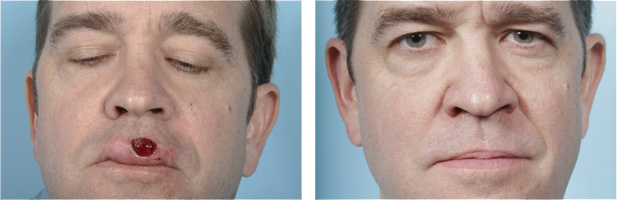
10 months post op
Check out Dr. Kim’s article “Cosmetic outcomes following head and neck melanoma reconstruction: the patient’s perspective” here.
For sensitive locations of the face following skin cancer excision, Dr. Kim may use precise primary closure to approximate the tissues carefully and judiciously. For larger defects after Moh’s surgery or skin cancer removal, Dr. Kim may need to use local flaps which are tissues rotated and transposed into the defect.
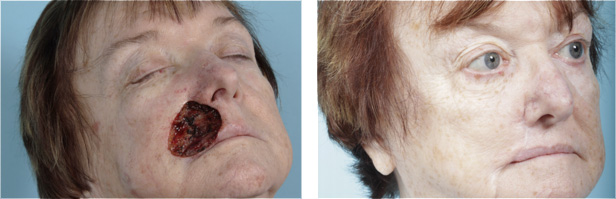
3 years post op
Care has to be taken in the face to make sure that the tissue rearrangement does not overly alter the neighboring structures of the eye, nose, cheek and mouth. There is some artistry that has to be matched with the technical function of the procedure. Dr. Kim has published research on the issues related to cosmetic outcomes from these types of procedures.
On rare occasions, more complex procedures such as a forehead flap are required to reconstruct the defect. This is especially true for nasal defects. Dr. Kim performs this procedure in several stages with the end result being a natural reconstruction of the nose.
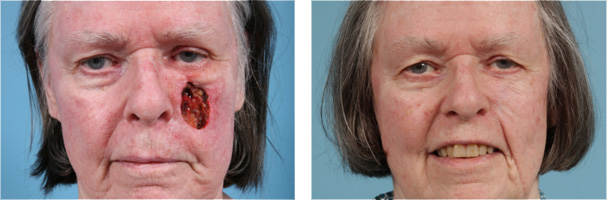
8 months post op
Additionally, there are times when Dr. Kim will take a skin graft from another part of the body and use it to cover a full-thickness defect from skin cancer excision and Moh’s surgery. This process takes a little longer to heal (4 weeks or more) and the skin color and texture will be slightly different from the native skin. However, in cases where a skin graft is used, there is often a paucity of local flap or primary closure options. These skin grafts will often be done in the operating room at Prentice Women’s Hospital or at Northwestern Memorial Hospital.
After surgery, Dr. Kim will continue to see you intermittently and employ a customized anti-scar regimen to help you optimize the appearance following Moh’s surgery or skin cancer excision.
Moh’s Before & After Compilation
Who Can Have Post-Mohs Reconstruction?
If you have undergone Mohs surgery to remove a skin cancer lesion, you may be a candidate for post-Mohs reconstruction. This specialized procedure is designed to restore the appearance and function of the area affected by cancer removal. You may benefit from reconstruction if your cancer was located on a cosmetically or functionally sensitive part of your body, such as your nose, lips, eyelids, or ears. These areas often require advanced techniques to maintain symmetry, natural contour, and proper movement.
You can also consider reconstruction if your Mohs procedure resulted in a larger or deeper wound than expected, or if the cancer removal involved critical structures like cartilage. In these situations, reconstruction helps support healing and reduces the risk of long-term deformity or compromised function. Dr. Kim will evaluate the size, depth, and location of your wound along with your skin type, overall health, and personal goals to determine the best reconstructive approach for you.
Some patients need a single-stage reconstruction using local tissue, while others may require staged procedures that allow your tissue to gradually adapt and heal. Regardless of the method, the goal is to help you recover fully while achieving the most natural aesthetic outcome possible.
Benefits and Risks of Post-Mohs Reconstruction
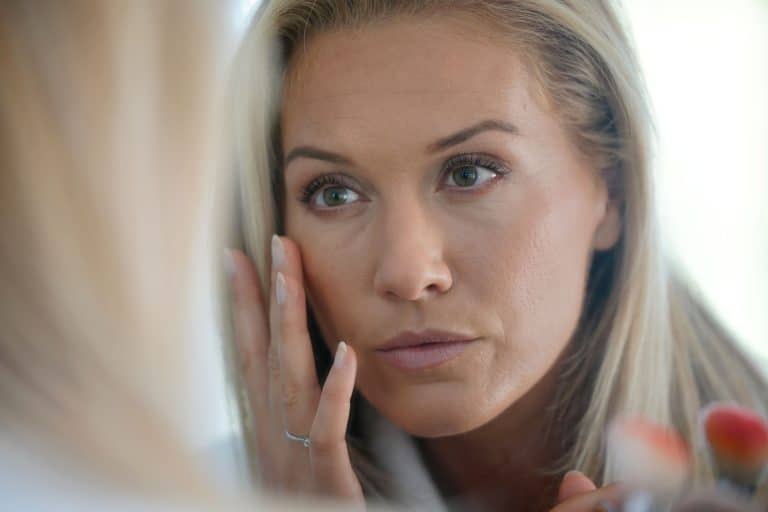
Post-Mohs reconstruction offers several key benefits that help you feel whole and confident after cancer removal. You gain improved cosmetic results through careful repositioning or reshaping of skin, cartilage, or underlying structures. This can restore harmony to your facial features or minimize visible scarring in highly noticeable areas. You also maintain or regain normal function, especially in areas involved in expression, breathing, speaking, or blinking.
Another benefit is that reconstruction helps support long-term skin health. Proper closure and tissue support can lower the risk of wound complications and encourage smoother healing. You also have the reassurance that your reconstruction is tailored to the exact nature of your cancer removal, with techniques chosen to complement Mohs surgery’s precise tissue-sparing approach.
As with any procedure, there are potential risks. You may experience bruising, swelling, scarring, or temporary discomfort as you heal. In some cases, the initial results may evolve over time as tissues settle. Complex wounds may require staged repairs or additional refinement to achieve the best possible outcome. Dr. Kim will review these considerations with you so you understand what to expect before, during, and after your reconstruction. His individualized planning helps reduce risks and ensures you receive care aligned with your goals and medical needs.
Why Choose Us
You deserve care from a surgeon who combines technical skill with a deep understanding of facial aesthetics, and Dr. Kim provides that level of expertise. As a board-certified plastic surgeon, he has extensive experience in post-Mohs reconstruction and understands the challenges of restoring areas affected by skin cancer treatment. You receive a personalized plan designed to protect both form and function, with techniques selected based on your anatomy and the unique details of your Mohs defect.
You also benefit from a patient-centered approach. You are guided through every step, from surgical planning to recovery, with clear communication and support. Dr. Kim focuses on natural-looking outcomes that blend seamlessly with your surrounding features. His practice offers advanced reconstructive options in a comfortable and professional environment in Chicago, IL.
If you are ready to explore your reconstructive options, you can contact the practice at 312-694-0879.
Skin Cancer Reconstruction FAQs
Is Skin Cancer Reconstruction Medically Necessary?
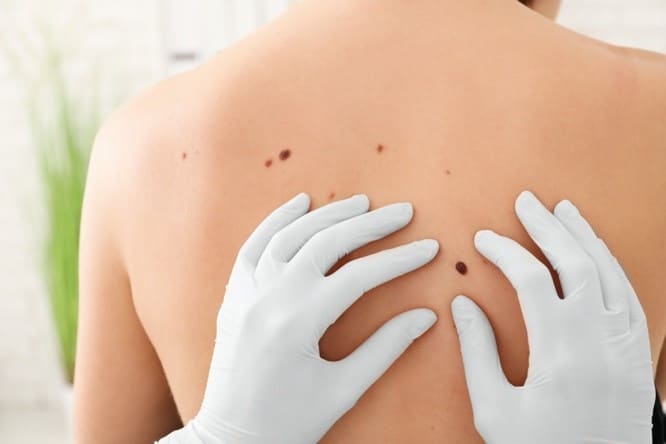
Skin cancer reconstruction is an essential part of Mohs surgery to promote proper healing and prevent mild to severe disfigurement. Plastic surgeons are regularly involved in the skin cancer excision process to ensure an aesthetically-pleasing result. That often requires closures, flaps or skin grafts. Dr. Kim will discuss your procedure, including any aspect that may be deemed “cosmetic.”
How Do I Care for My Skin After Skin Cancer Reconstruction?
Follow your wound care instructions from Dr. Kim, which include cleansing the area and applying topical medications. Avoid light activity until you are cleared to resume your everyday tasks and be sure to keep incisions clean. Try to limit movement in the area to prevent stressing the wound and sutures.
Do I Need to Avoid Sun Exposure After Mohs Surgery and Reconstruction?
Exposing healing wounds to the sun may cause irregular pigmentation, resulting in raised, red or dark scars. Sun exposure also increases your risk of skin cancer recurrence. Avoid time in direct sunlight until your incision site has healed, and apply sunscreen to all exposed face and body areas.
Can Skin Cancer Come Back After Mohs Surgery and Reconstruction?
There is a risk for skin cancer recurrence depending on certain factors such as the size, border, growth rate and location of the tumor. However, skin cancer is less likely to come back after excision and least probable after Mohs surgery. An evaluation of the five-year recurrence rate among post-op patients who had skin cancer excision or Mohs surgery found the recurrence rate for basal cell carcinoma was 2% for excisions and 1% for Mohs surgery.
In cases where the skin tumor returns, Mohs surgery is still the preferred option. In squamous cell carcinoma, the five-year recurrence rate was 3% for Mohs and 8% for excisions. Some forms of skin cancer require additional treatment, such as radiation therapy. Follow-up appointments after Mohs surgery and skin cancer reconstruction are crucial for the early detection of new skin lesions.
How Long Is Recovery from Skin Cancer Reconstruction?

The incision site may be sore and red. You could experience some fluid drainage, and healing will continue for weeks, maybe months, depending on the extent of your procedure. How long your incision takes to heal depends on the size and location of the skin cancer and how well your recovery goes. Make sure you avoid excessive motion, swelling and abrasion in the area as you heal.
Do Skin Cancer Reconstruction Scars Go Away?
Dr. Kim makes every effort to avoid significant scarring by concealing incisions where applicable, but no surgery is without scars. Scars from skin cancer reconstruction may never fade away but will improve and blend with surrounding skin as time passes. It may take a year or longer for incision lines to lessen. Sometimes, a secondary procedure is required to refine your appearance.
Where Is the Skin Removed for a Skin Graft?
Tissues for a skin graft are typically removed from a less visible body area then moved to the treated area. A base is created using the relocated skin tissue, which reduces scarring and quickens wound healing.